

Autism is a spectrum. This means autistic people have different strengths, challenges, and support needs. One person may need help only in certain situations, while another may need significant support throughout the day.
When someone is diagnosed with autism, a clinician may describe their support needs using Level 1, Level 2, or Level 3. Some people refer to these as levels of “severity.” The levels come from the Diagnostic and Statistical Manual of Mental Disorders, Fifth Edition, Text Revision (DSM-5-TR).
The levels are:
- Level 1: Requiring support
- Level 2: Requiring substantial support
- Level 3: Requiring very substantial support
The levels are considered separately in two areas: social communication and interaction and restricted or repetitive behaviours. A person may have different support needs in each area.
Some people with Level 3 support needs may also be described as having profound autism. This term is used for some autistic people with very significant, long-term support needs. The terms are related, but they do not mean the same thing.
What each level can look like
Level 1: Requiring support
At Level 1, autism characteristics cause noticeable difficulties without support.
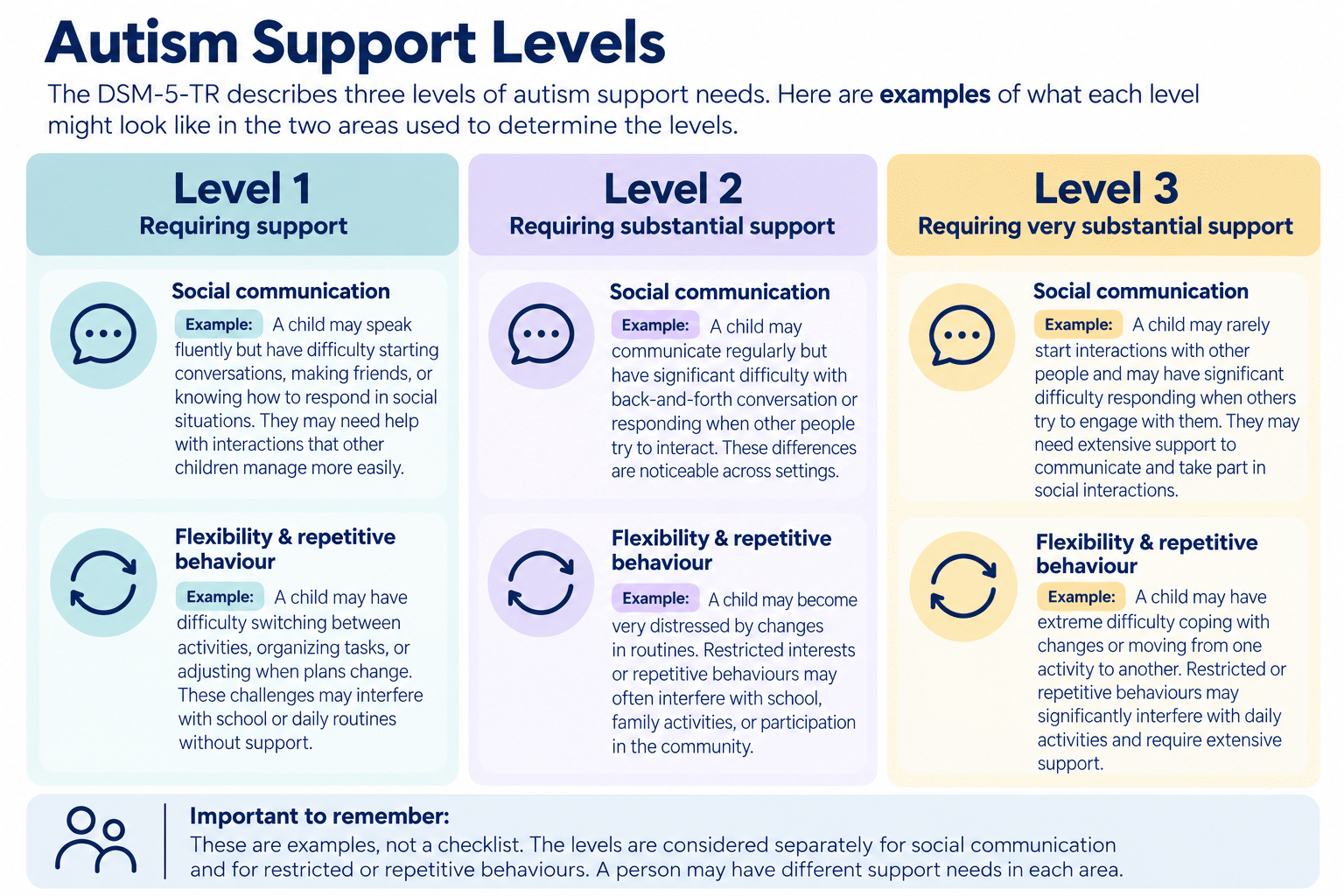
Social communication example: A child may speak fluently but have difficulty starting conversations, making friends, or knowing how to respond in social situations. They may need help with interactions that other children manage more easily.
Flexibility and repetitive behaviour example: A child may have difficulty switching between activities, organizing tasks, or adjusting when plans change. These challenges may interfere with school or daily routines without support.
Level 2: Requiring substantial support
At Level 2, autism characteristics have a greater impact on everyday life, even when some supports are already in place.
Social communication example: A child may communicate regularly but have significant difficulty with back-and-forth conversation or responding when other people try to interact. These differences are noticeable across settings.
Flexibility and repetitive behaviour example: A child may become very distressed by changes in routines. Restricted interests or repetitive behaviours may often interfere with school, family activities, or participation in the community.
Level 3: Requiring very substantial support
At Level 3, autism characteristics have a major impact on everyday life, and very substantial support is needed.
Social communication example: A child may rarely start interactions with other people and may have significant difficulty responding when others try to engage with them. They may need extensive support to communicate and take part in social interactions.
Flexibility and repetitive behaviour example: A child may have extreme difficulty coping with changes or moving from one activity to another. Restricted or repetitive behaviours may significantly interfere with daily activities and require extensive support.
What about “high-functioning” and “low-functioning”?
You may still hear people described as “high-functioning” or “low-functioning.” These are not official diagnostic terms, and they can give an incomplete picture of a person’s abilities and needs.
Calling someone “high-functioning” can make their support needs seem more minimal than they are. For example, a person may speak fluently and do well at school but struggle with daily living, flexibility, or social situations.
“Low-functioning” can create the opposite problem by reducing a person to their areas of greatest difficulty. For example, a person may need extensive support with communication and daily living skills while still having clear preferences, strengths, interests, and abilities that the label does not capture.
Instead of using broad functioning labels, TALES strongly recommends describing three things: 1) what a person can do, 2) where they have difficulty, and 3) what support they need.
Putting the autism levels in context
The DSM-5-TR levels are useful for describing the impact of autism characteristics, but they do not give a complete picture of a person.
Two people with the same level may have very different abilities and needs. Autism levels also do not tell us a person’s intelligence, language abilities, daily living skills, personality, or potential. Other factors may also affect how much support someone needs. These can include intellectual disability, language differences, anxiety, ADHD, and medical conditions.
Support needs can also change over time and across situations. A child may need less support in a familiar setting but much more support in a busy classroom or unfamiliar community setting.
Ultimately, autism levels are useful when understood for what they are: a way to describe support needs in specific areas at that time. They provide important information, but they are only one part of understanding the support a person needs.
References
- American Psychiatric Association. (2022). Diagnostic and statistical manual of mental disorders (5th ed., text rev.). American Psychiatric Association Publishing.
- Autism Alliance of Canada (formerly Canadian Autism Spectrum Disorder Alliance). (2020). Language guide.
- Hyman, S. L., Levy, S. E., & Myers, S. M. (2020). Identification, evaluation, and management of children with autism spectrum disorder. Pediatrics, 145(1), e20193447. https://doi.org/10.1542/peds.2019-3447
- Lord, C., Charman, T., Havdahl, A., et al. (2022). The Lancet Commission on the future of care and clinical research in autism. The Lancet, 399(10321), 271–334. https://doi.org/10.1016/S0140-6736(21)01541-5
- Public Health Agency of Canada. (2024). Framework for Autism in Canada. Government of Canada
- Weitlauf, A. S., Gotham, K. O., Vehorn, A. C., & Warren, Z. E. (2014). Brief report: DSM-5 “levels of support:” A comment on discrepant conceptualizations of severity in ASD. Journal of Autism and Developmental Disorders, 44(2), 471–476. https://doi.org/10.1007/s10803-013-1882-z
Get in touch
It’s okay if you’re not sure where to start.
You don’t need to know exactly what kind of support you’re looking for. Tell us what’s going on, and we’ll help you understand the options.
Book a free consultation
Tell us about your child, your concerns, and any past assessments or support.
Get a recommendation
We’ll talk about how we can provide support and give you clear information about services and fees.
Decide what’s right for you
Move forward when you’re ready, with no commitment before then.